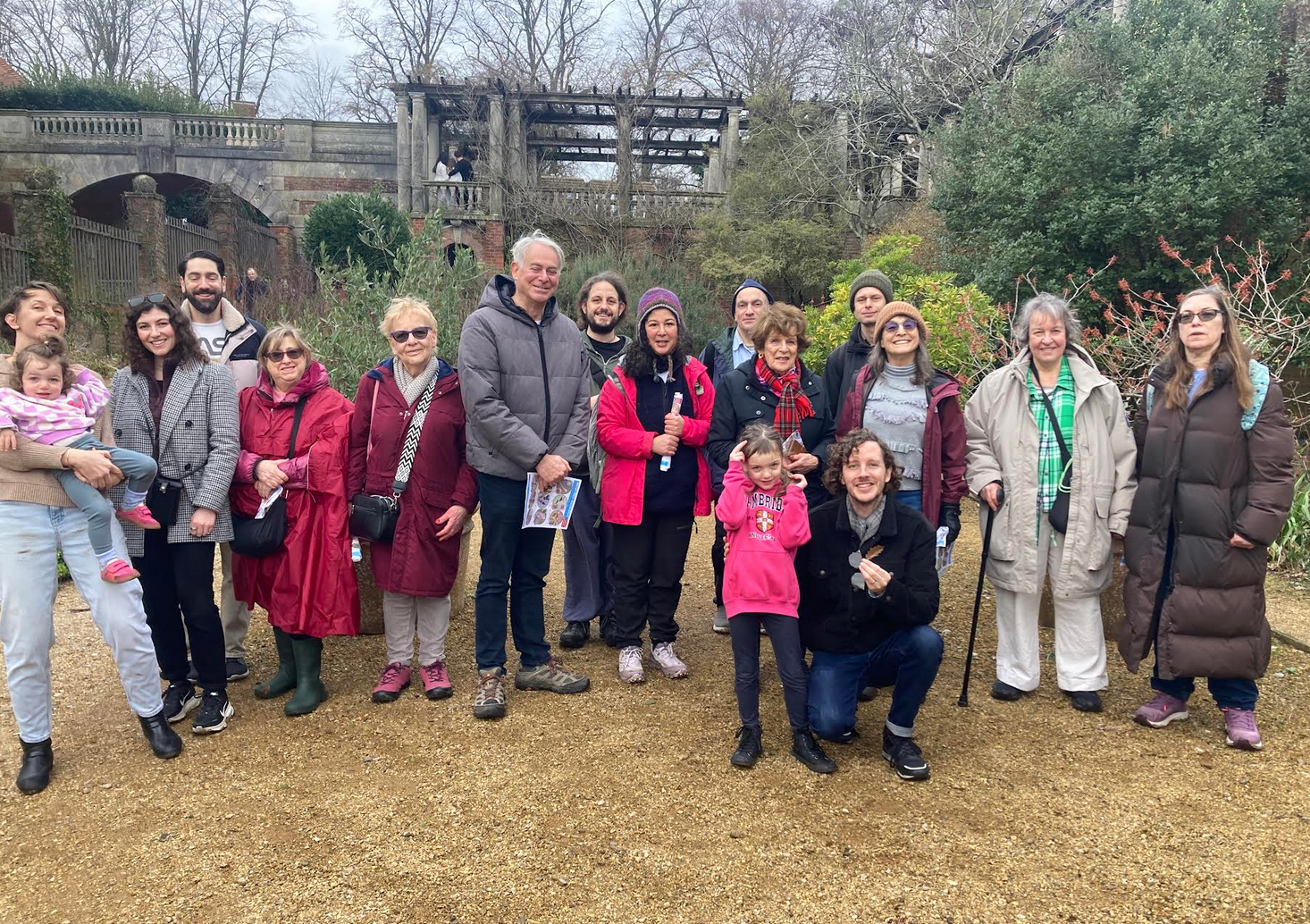
On Sunday we had our first of two events to mark Tu B'Shvat - our ‘meet the trees’ walk, led by Genevieve Passamante, forest school teacher.
It was a glorious afternoon and we were super lucky with the sunny, dry weather. It felt so good to be outside in the fresh air and being in community - with each other and the trees. Our intention was for this to be a co-created walk, with each person bringing their own knowledge and wisdom.
Genevieve did a fantastic job of leading us through the park, with her knowledge and passion for this subject and showed us how to identify the different trees in winter from their branches and fallen leaves, amongst them were yew, oak, hazel and elder.
She spoke about one of the old oaks as a veteran tree as it is showing signs of decay and this is significantly important as the hollows, rugged bark provide vital habitats for insects, rare fungi birds and bats, trunks, and rugged bark provide vital habitats for rare fungi. As they get older, the oaks put out their supporting branches. The oak is considered a key stone species as it supports so much wildlife. Oaks are mentioned in the Torah and symbolize strength and longevity.
As we moved on to look at some broad leaf native trees on route to the pergola, Genevieve referred to a study conducted by UCl which found that Hampstead Heath stores up to 178 tonnes of carbon per hectare a year. This high capacity makes its’ carbon density comparable to some tropical rainforests. The 320-hectare park acts as a vital carbon sink; part of the wider London urban forest, offsetting local emissions. This study highlights the importance of trees in an urban environment.
We explored how willows are a keystone species as they are the host plants for over 300 different kinds of moths and butterflies - key food for birds, pollen for bees, branches for nest building.
Trees have medicinal properties and many of our medicines are derived from plants but equally plants can be toxic and therefore it is important to understand the nature of plants and their uses.
We even spotted some of the seven species on our walk; an olive and more surprisingly - a pomegranate tree
We discussed our interconnectedness to trees and the idea of trees having souls. In the words of Rabbi Nachman of Bratzlav “cutting down a tree before its time is like killing a soul.”
We finished with a poem from Yiddush poet Yehoash:
Consider the life of trees.
Aside from the ax, what trees require from man is inconsiderable.
What man may require from trees is immeasurable.
From their mute forms there flows a poise, in silence, a lovely sound and motion in response to the wind.
What peace comes to those aware of the voice and bearing of trees!
Trees do not scream for attention.
A tree, rock, has no pretense, only real growth out of itself, in close communion of the universal spirit.
A tree retains a deep serenity.
It establishes in the earth not only its root system but also those roots of its beauty and its unknown consciousness.
Sometimes one may sense a glisten of that consciousness and with such perspective, feel that a man is not necessarily the highest form of life.
Tree qualities after long communion, come to reside in man.
As stillness enhances sound, so through little things the joy of living expands. One is aware, lying under trees, of the roots and directions of one’s whole being. Perceptions drift in from earth and sky.
A vast healing begins.
Thank you everyone who joined and huge thanks to Genevieve for hosting this magical walk!