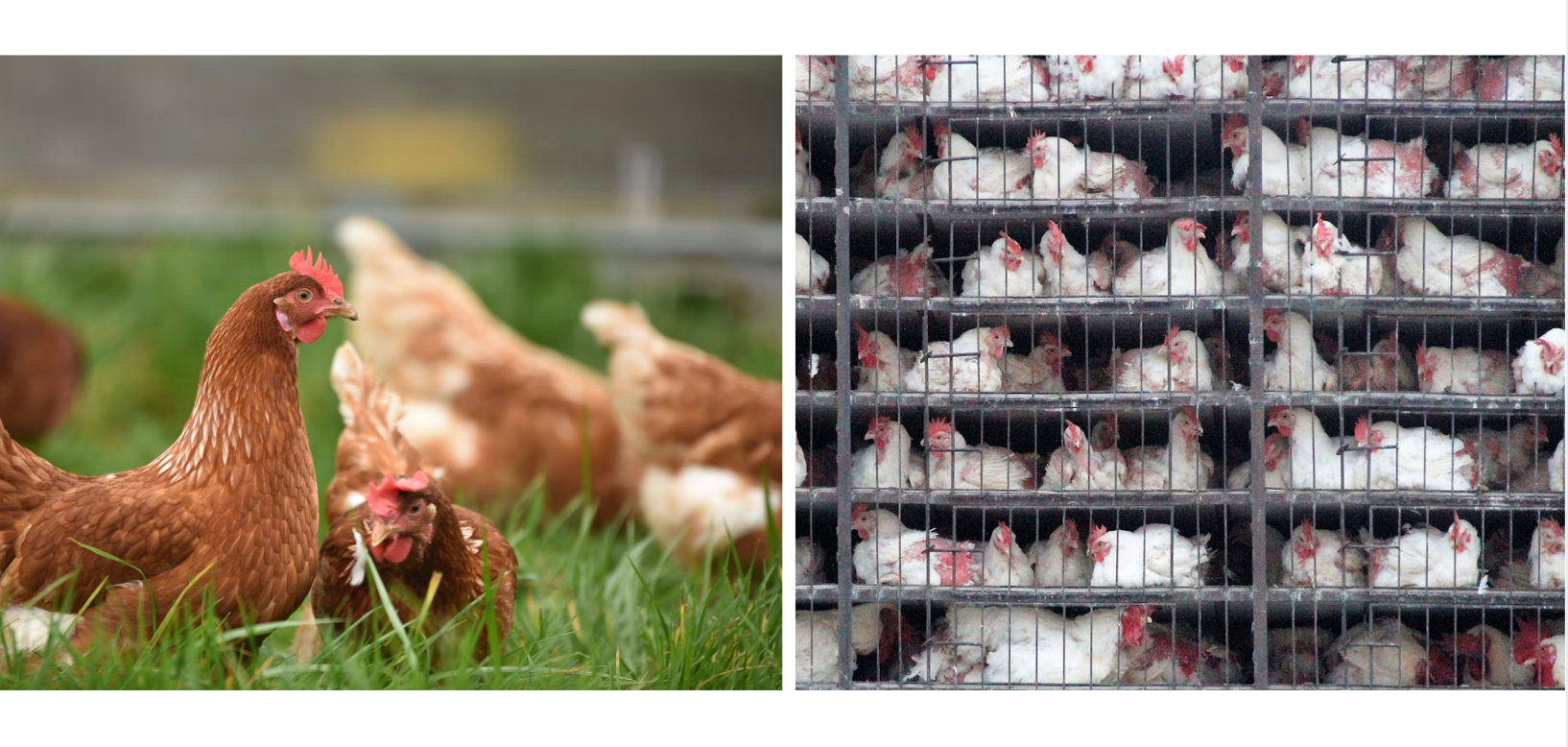
If you keep pet chickens in your garden, you are bound by animal welfare laws. According the Animal Welfare Act 2006, you have a legal duty of care to provide for your chickens' five basic needs: a suitable environment, a proper diet, the ability to exhibit natural behaviors, appropriate housing with or apart from other animals, and protection from pain, suffering, injury, and disease. Failing to meet any of these needs or neglecting a sick hen can result in heavy fines, a ban on keeping animals, or even prison time. Meanwhile millions of poultry birds live in conditions that would see a pet owner prosecuted. This is the legal paradox of the modern British chicken.
Although the UK banned standard battery cages in 2012, they were replaced by ‘enriched’ colony cages. Naturally the commercial farming lobby promoted these as a success for animal rights. In reality, the legal requirements for an enriched cage only require a tiny scratching area, a plastic perch, and a curtained nesting area shared by up to 80 birds. UK legislation protects commercial farms from animal cruelty charges because these practices are dismissed as standard agricultural exemptions. Could the moral hypocrisy be more absurd?
If a pet owner reduced their dog, cat, or even a pet parrot to an equivalent amount of space for its entire life, the RSPCA would intervene immediately. Ultimately this demonstrates that UK law reduces the suffering of a chicken from what the animal feels to who ‘owns’ it and what its ‘purpose’ is. Our legislation dictates what amount of animal suffering is allowed according to whether we see the animal as a ‘pet’ or ‘product’. If only chickens were considered as inedible as a dog or cat, they’d be safe from the moral and legal contradictions which permit large scale suffering.
If UK dog and cat owners restricted their meat, dairy, and egg consumption exclusively to products raised in conditions they would be willing to subject their own beloved pets to, the industrial factory farming system would collapse overnight.