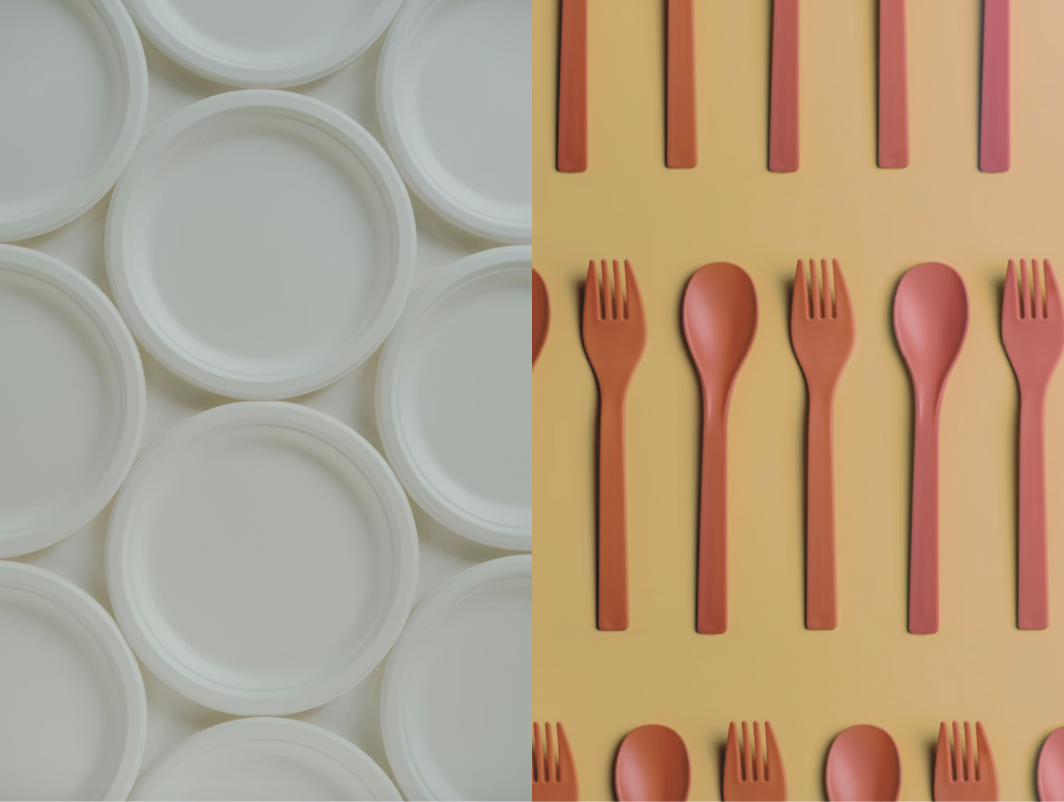
The Jewish community has an unhealthy relationship with disposables. Shabbats, festivals, celebrations and Yom Tovs are popular times for using disposables to facilitate the cleanup of these occasions. Even when we’re not cooking, many kosher catering businesses use large plastic platters, while many smaller kosher shops often do not adhere to charging the legal fee for plastic bags. Our use of plastic disposables has detrimental consequences for our environment, animals and our health, implicating a variety of important Jewish values. Additionally, even the more ‘eco-friendly’ alternative disposables are not ideal, rendering reusable crockery the most coherent with good Jewish living.
Most plastic utensils are made or non-recyclable materials; approximately only 9% of manufacturers make their products from recyclable shapes and materials. These plastic utensils can take between 200-450 years to decompose and are one of the most harmful forms of sea pollution as they can be consumed and lodged in the throats and intestines of sea animals. Where these products cannot be recycled, they are often discarded incorrectly and end up incinerated. Unfortunately, the market price for single use plastic utensils and cutlery do not reflect the extent of the detrimental environmental impacts. Even alternatives to single use plastics also have detrimental environmental implications. Bioware require large areas of land for production and are often carbon intensive. Moreover, very few are processed correctly and still take about 3-5 year to degrade in seawater. Ultimately, we must remember that plastic never simply ‘goes away’, it is only reduced to smaller particular matter.
These environmental impacts must be seriously considered; in the midrash, it is written “Upon creating the first human beings, God guided them around the Garden of Eden, saying: “Look at my creations! See how beautiful and perfect they are! For your sake I created them all. Make sure you don’t ruin or devastate My world. If you do, there will be no-one else to repair it.” (Ecclesiastes Rabbah 7:13)
Disposable crockery also has various implications to human health. Microplastics (MPs) are released from disposable products when in contact with both hot and cold food and can be defined as any plastic fragment up to 5mm long. Exposure to these microplastics has been found to likely be associated with cardiovascular issues, cancer and reproductive issues, endocrine disruption, inhibited immune functioning and potentially developmental concerns among children to name a few. Nonetheless research is still limited, meaning the full extent of damage to human health is unknown.
Even ‘eco-friendly’ non-plastic alternatives have also been found with different health risks including the secretion of toxic chemicals into our food. Indeed most ‘paper’ disposable plates and cups are actually lined with plastic (Plastic polyethylene PE) which can release harmful microplastics and toxins.
Some improvements are slowly being made; many kosher supermarkets provide eco-friendly disposables, and more and more synagogues are reducing their use of single use plastic; Mill Hill United Synagogue have banned all single use plastics and Golders Green United Synagogue has banned all disposables and Stanmore United only use environmentally friendly disposables. Where necessary, ‘eco-friendly’ bioware is a considerable improvement to the harmful plastic products, but ultimately it is evident that permanent crockery is the most eco-friendly option and the most beneficial to our health. Acting in according with the values of tikkun olam, and in the best interests of our health and the health of our community is a joint responsibility. It is time we consider disposables as ‘traif’, and unaligned with our religious and cultural values.
Find here United Synagogue’s free shul guide to phasing out disposables:
https://theus.org.uk/assets/uploads/2023/12/phasing_out_disposables_shul_guide_june_2023.pdf